
All plug-ins
John’s Guitar
Guitar effects chain
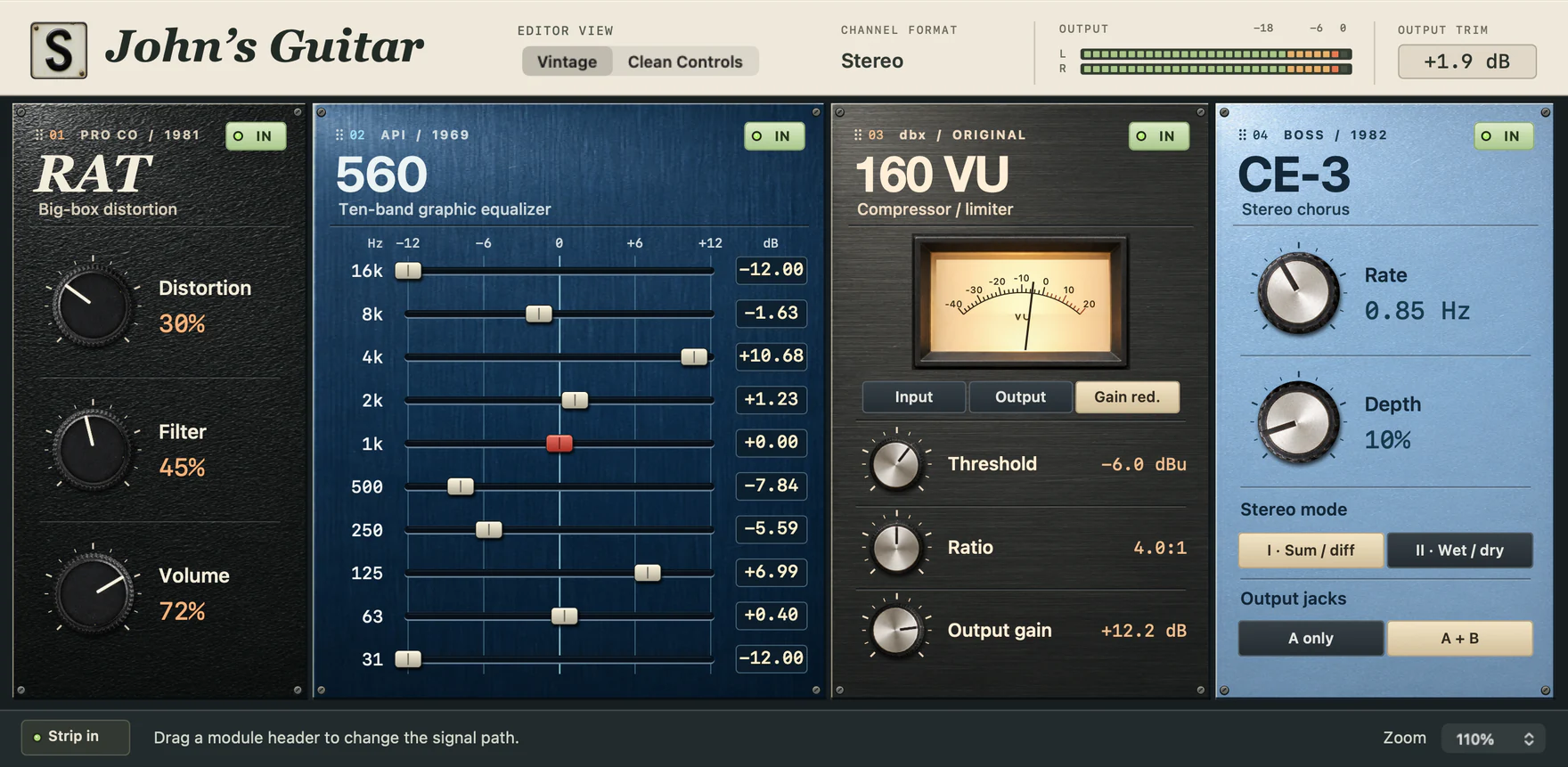
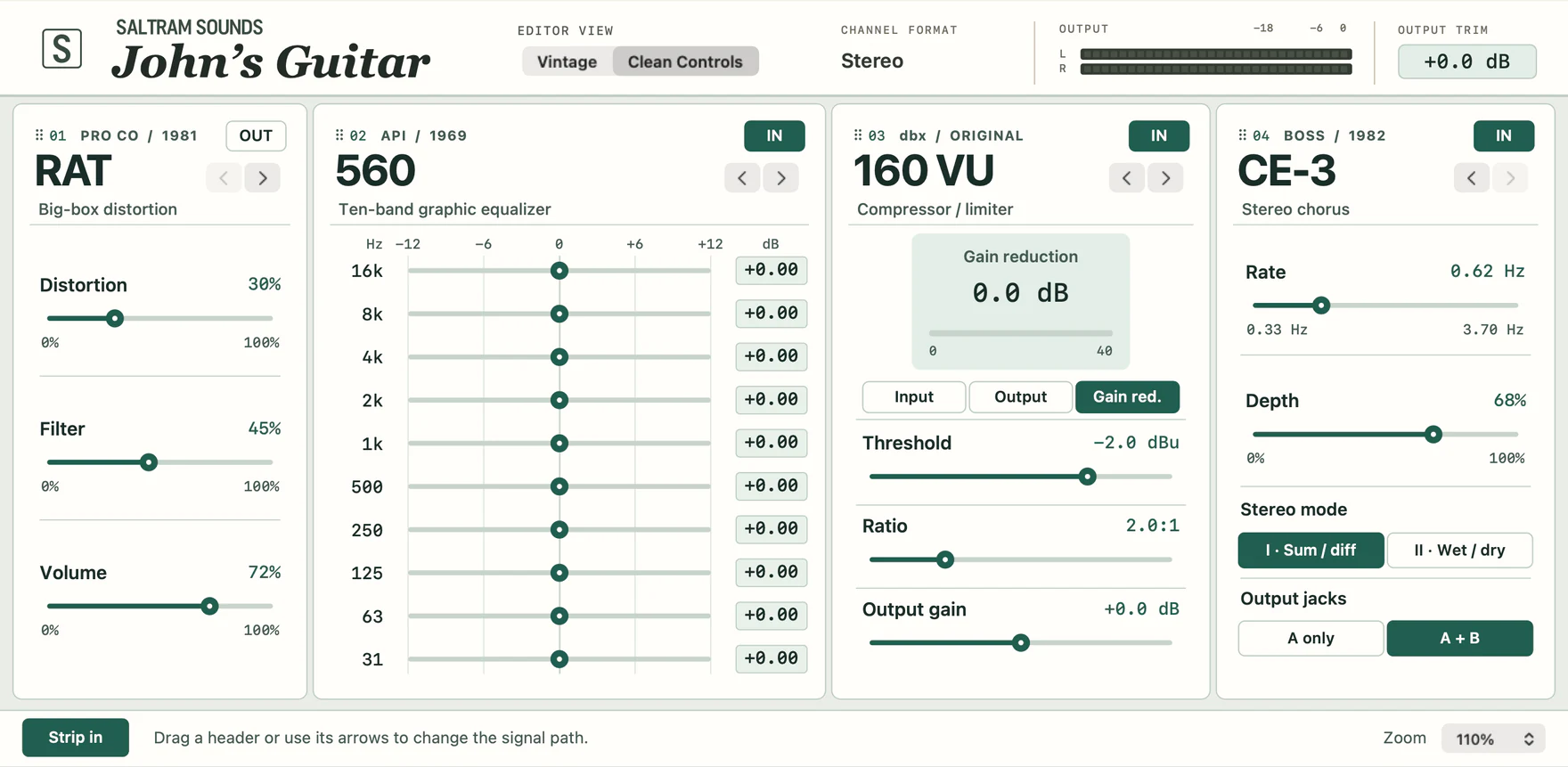
Move the EQ ahead of the distortion to change how a chord breaks up. Add stereo chorus to give a single guitar some width as it rings out.
Where the compressor goes
Play a chord softly, then dig in. Lower the threshold until the gain-reduction meter moves on the louder chord. Ahead of distortion, the compressor changes how hard the chord drives the clipping stage. After distortion, it controls the level of the clipped sound.
- Distortion and EQ
- A RAT-style clipping stage and a ten-band graphic give you two ways to shape the bite. Swap their order to change which frequencies hit the distortion hardest.
- Compression
- A hard-knee, RMS-sensing 160-style compressor catches the body of a chord. Change the threshold while you watch the gain-reduction meter.
- Stereo chorus
- Choose a mono-to-stereo insert to hear both outputs of the CE-3-style chorus. Mode II puts the modulated signal on one side and the direct signal on the other.
Keep the pick, widen the tail
- Open a mono-to-stereo instance on a guitar track and load CE-3 / Wide clean. Play a few short downstrokes.
- Switch the chorus out and back in. Listen to the centre of the pick attack and to the two sides as the chord decays.
- Choose the A + B chorus output. Compare its two modes, then check the result in mono.
What’s modelled
The four effects model documented circuits and controls. They have yet to be matched to individual physical units. The chain contains effects only. Bring your own amp or cabinet sound if the part needs one.
A rhythm part, then the chorus return
Listen to the pick attack in the centre and the movement on either side of it.
- Dry
- Dry rhythm phrase
- Processed
- CE-3 / Wide clean
Audio demo pending.
Specifications
- Format & version
- AUv2 · 1.2.4
- Build target
- macOS 13 or later
- Processor
- Apple silicon & Intel
- Channel layouts
- Mono, mono to stereo, stereo